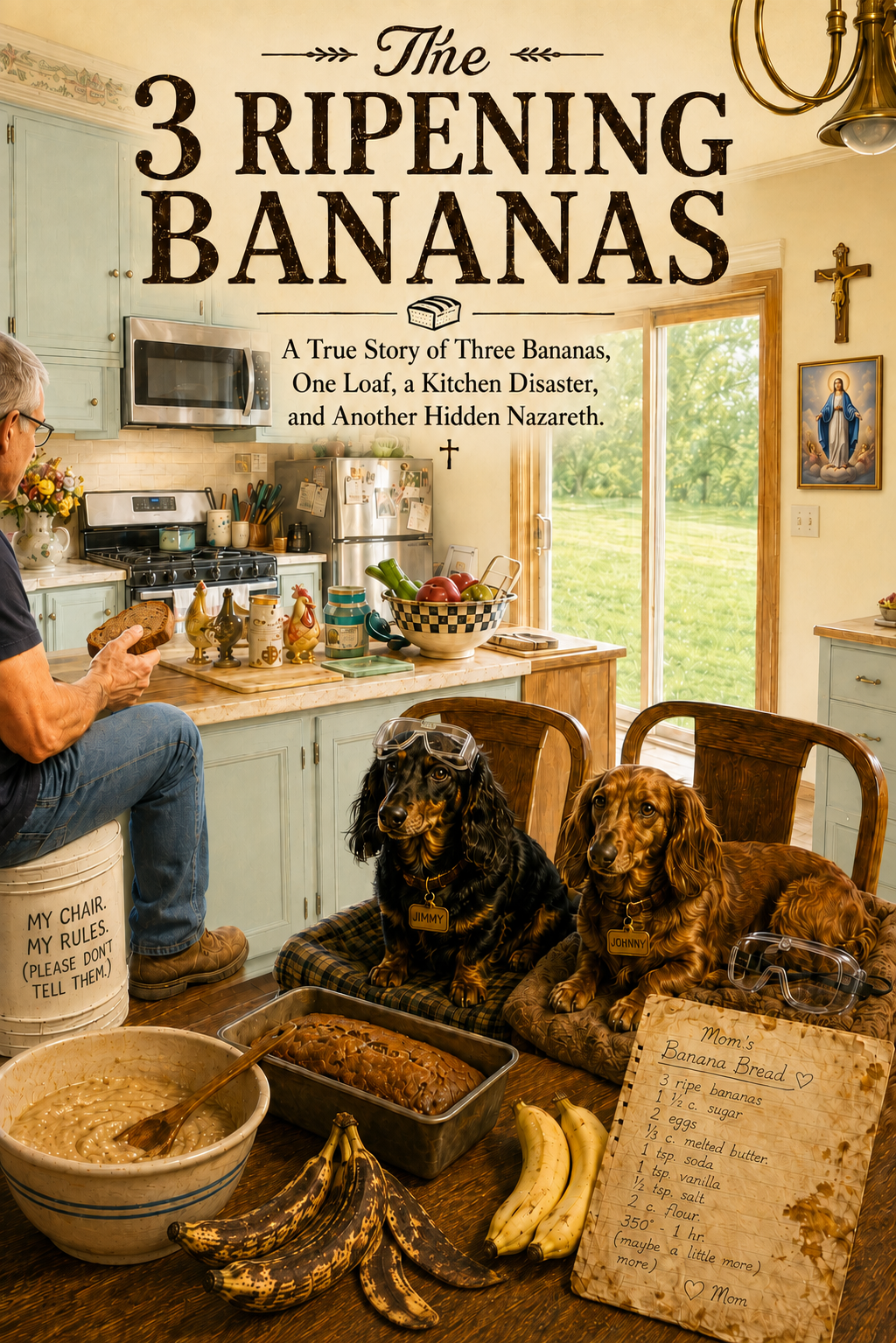
There were three bananas sitting on my counter.
They had been sitting there for several days, getting progressively riper while I tried to decide what to do with them.
I knew what I wanted.
Mom's banana bread.
What I did not particularly want was to make it myself.
So I approached my sister Julia with what I considered a perfectly reasonable division of labor.
I would provide the bananas.
She would make the banana bread.
Julia responded by sending me a picture of Mom's old recipe card.
In other words:
You do it.
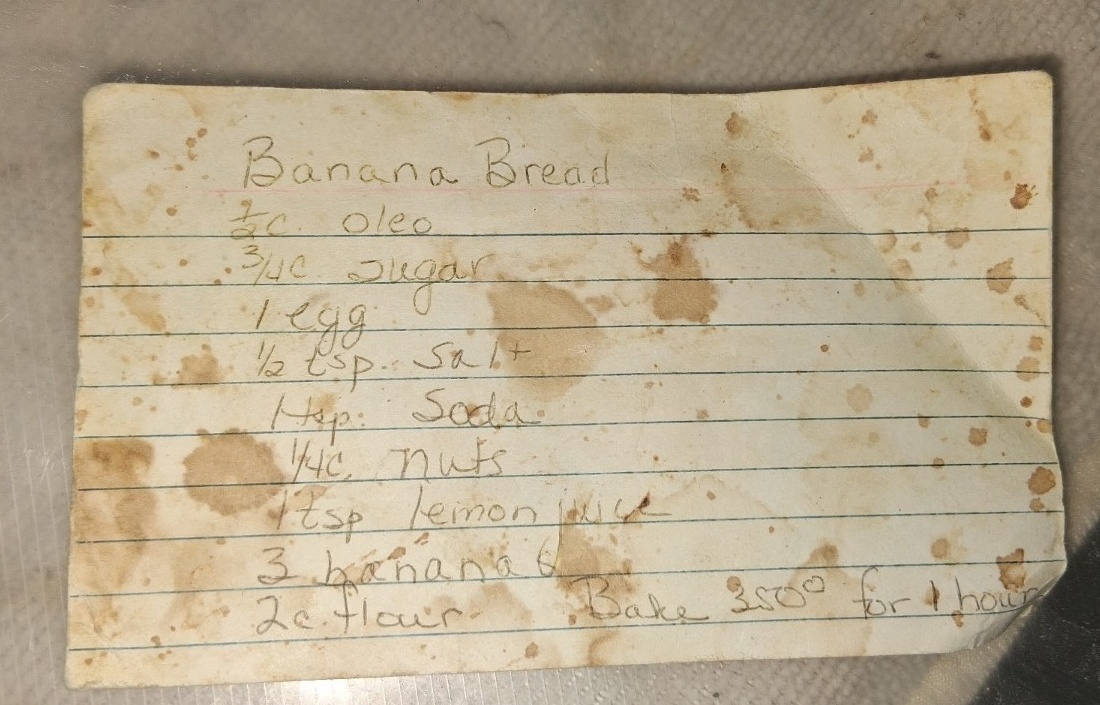
Mom's original banana bread recipe card.
The card looked exactly like something that had survived our family.
Old and yellowed. Written in pencil on lined paper. Rounded corners. Stains scattered across it from years of use.
Mom's handwriting was still there.
Simple enough.
Except I immediately encountered a problem.
Oleo.
I had no idea what oleo was.
I asked my sister Margaret:
Me: "Is there such a thing as banana bread oleo?"
Margaret explained that oleo was margarine.
Apparently people once knew this.
I did not.
I had butter.
Butter seemed close enough.
So I put it in the microwave for thirty seconds.
When I checked it, the butter was nearly melted.
I decided it needed another ten seconds.
I punched in ten seconds and pressed Enter.
Approximately two seconds later:
BOOM.
Butter everywhere.
The inside of the microwave looked as though a small dairy device had detonated.
I hadn't even mashed a banana yet.
Mom had raised eight children in ten years.
I had been making banana bread for approximately four minutes and had already blown up the butter.
This was not encouraging.
Margaret had originally planned to help me make the bread.
But the day wasn't cooperating.
Earlier, I had taken Jimmy and Johnny to get vaccinated, and by the time I got home I was exhausted.
It was the Feast of the Assumption, and I tried to watch Mass on EWTN.
I fell asleep.
I woke up and tried again.
I fell asleep again.
Margaret was going to the vigil Mass and had dinner plans afterward.
Julia had already made her position clear.
Meanwhile, the bananas continued their relentless march toward decomposition.
There comes a point in the life of a banana when discussion is over.
Something must be done.
So I was on my own.
Well...
Almost.
After the butter explosion, I decided perhaps some outside assistance might be prudent.
I turned to ChatGPT.
This was the moment Laurel met Hardy.
Which of us was Laurel and which was Hardy would change repeatedly over the next couple of hours.
I began with a perfectly reasonable question.
Mom's recipe called for nuts.
Me: "Should I also throw in some washers?"
I was advised that walnuts or pecans were preferable, although technically hex nuts might satisfy the wording of the recipe.
This was useful information.
Then I needed to grease the bread pan.
Me: "Should I use 80-90 weight?"
Apparently gear oil is not recommended for banana bread unless the loaf pan has a limited-slip differential.
Fortunately, I had a brand-new can of cooking spray.
So I greased the pan.
With the entire can.
Apparently "grease the pan" does not mean "empty a full aerosol can into it."
Recipes really should be more specific about these things.
My unseen kitchen companion informed me that I had essentially pressure-washed the pan with cooking spray and predicted that my banana bread might leave the pan at sixty miles per hour.
I thought this was an exaggeration.
Then the pan literally slid off the counter toward the oven.
I began to wonder whether ChatGPT knew me better than I knew myself.
There was another problem.
The oven was full.
Not with food.
With stuff.
Pans.
Trays.
Baking dishes.
Rolling pins.
More pans inside other pans.
Things I had apparently stored there because cabinets have doors and ovens also have doors, so the distinction had become unnecessarily technical.
I sent a picture.
The response was immediate.
YES. ALL OF IT HAS TO COME OUT.
So I removed everything from the oven.
And stacked all of it on top of the stove.
I sent another picture.
This produced considerably less enthusiasm.
Apparently removing everything from the oven and constructing a bakeware Jenga tower directly over the gas burners did not constitute an adequate safety improvement.
I moved it.
By now Jimmy and Johnny were probably wondering whether their vaccinations included protection against kitchen explosions.
I have noticed that whenever I bake, the boys put on goggles.
I used to think this demonstrated a lack of faith.
Now I am beginning to think they simply have good judgment.
There were still ingredient questions.
If I were out of flour, could I use rice?
If I were out of sugar, could I use marshmallows?
If I were out of lemon, could I use lime?
If the recipe called for an egg, should I hard-boil it or fry it first?
And since I intend someday to become a trillionaire through broccoli, wouldn't broccoli improve the nutritional profile?
By this point my unseen kitchen companion had stopped merely answering questions and had become an accomplice.
We discussed washers as a source of iron.
We discussed marshmallows as vegetables, provided nobody asked too many questions.
We agreed that broccoli might actually be the healthiest ingredient I had proposed.
We discussed the egg.
It should be raw.
Apparently this needed to be stated.
Eventually, despite considerable evidence that Providence might be trying to stop me, the banana bread went into the oven.
Three hundred and fifty degrees.
Mom's card said one hour.
After twenty minutes, I asked whether it was done.
I am not a patient man.
I pointed out that if baking were linear, then after thirty minutes half the loaf should be finished.
This was important because company was coming in half an hour.
I could serve them the finished half when they arrived and package the remaining half when they left.
My kitchen companion introduced me to the Generally Accepted Banana Principles.
Under GABP, apparently, banana bread does not qualify for straight-line baking.
This was particularly disappointing to me as an accountant.
The entire loaf insists upon baking simultaneously.
I still think my method has merit.
Eventually we discussed how I would determine when the bread was done.
Normally one inserts a toothpick into the center.
I didn't have a toothpick.
For safety reasons.
I did, however, have a sword.
I asked whether that would work.
By this point neither Laurel nor Hardy was exercising adequate adult supervision.
Then I looked around my kitchen.
There were dishes everywhere.
I had made one loaf of banana bread.
One.
Yet somehow I had generated approximately two dishwasher loads.
Me: "Why does one banana bread equal two dishwashers full of dishes?"
We laughed about banana bread having a dish-multiplication coefficient.
And then I thought about Mom.
She would never have had this mess.
By the time my mother's banana bread went into the oven, every dish she had used would have been washed.
Ingredients put away.
Counters wiped.
Kitchen back in order.
She was remarkably organized.
Of course, she had to be.
She had eight children in ten years.
When I was young, I thought of Mom as the drill sergeant's drill sergeant.
There was a right way to do things.
There was a place where things belonged.
And if something needed done, there was a very good chance that the appropriate time to do it was:
Now.
As a child, I noticed the drill sergeant.
Standing in my kitchen surrounded by dirty dishes, I began noticing something else.
I had made one loaf.
Mom did this all her life.
Meals.
Bread.
Laundry.
Cleaning.
Children.
Again and again and again.
A child doesn't see most of that.
A child sees banana bread.
It simply appears.
You walk into the kitchen and there it is.
Maybe you grab a piece.
Maybe you ask whether you can have another.
You don't count the dishes.
You don't think about the measuring cups.
You don't think about cleaning the kitchen.
You certainly don't contemplate the emotional significance of oleo.
Mom made it.
That's what moms do.
It took me all these years and two dishwasher loads to see the other side of the loaf.
All this work.
All these dishes.
Was it worth it?
Almost as soon as I asked the question, I knew the answer.
Love explains it, I guess.
My mother didn't always understand my humor.
Considering the events of this particular afternoon, perhaps that was reasonable.
And when Mom pointed - or shook - that finger at me, it certainly didn't always mean I was about to hear something affectionate.
There were eight of us.
I knew that finger.
Sometimes it meant I had done something.
Sometimes it meant I had better stop doing something.
Sometimes it meant whatever I was thinking about doing next would be an exceptionally poor idea.
Those were not the moments I'm talking about.
Every once in a while, usually after something I had said or done managed to get through to her sense of humor, Mom would look at me.
The finger would come up.
She'd point it right at me.
And instead of what I might ordinarily have expected, she'd say:
"I love you, Michael."
Those were the good times.
Maybe that's why I remember them so clearly.
Same mother.
Same finger.
Very different message.
I can still see it.
And I can still hear her voice.
And suddenly the kitchen felt different.
The laughter hadn't disappeared.
But something had joined it.
Memory.
Warmth.
A few tears.
Good tears.
I thought about Dad too.
Dad was quieter when it came to the family and household.
But quiet should never be confused with absent.
My father got up and went to work every day to provide for us.
All ten of us.
While Mom was doing the work I could see happening inside our home, Dad was doing the work that helped make that home possible.
And Dad loved us.
All of us.
Deeply.
He didn't necessarily express it the same way Mom did.
He was Dad.
His love had its own language.
So did his faith.
Dad had a strong sacramental faith.
The Church wasn't something added around the edges of family life.
The sacraments mattered.
God mattered.
Faith mattered.
As a child, I don't think I understood everything he was giving us either.
Children rarely do.
And somehow, on this particular afternoon, I began thinking about another family.
Another home.
Nazareth.
Mary.
Joseph.
Jesus.
Joseph was a working father too.
Scripture does not preserve a single word spoken by him.
But silence did not mean Joseph contributed little to the Holy Family.
Quite the opposite.
He worked.
He provided.
He protected.
He obeyed God.
He practiced his faith.
He loved Mary.
He loved the Child entrusted to him.
And day after ordinary day, he helped make a home in which Jesus could grow.
Mary's work was there too.
The countless ordinary acts of a mother that Scripture never records because the Gospel isn't a household diary.
Meals had to be prepared.
Clothes had to be cared for.
A home had to be kept.
Bread had to be made.
And Jesus grew up surrounded by both of them.
A mother and a father.
Two different ways of loving.
One home.
Most of it hidden from the world.
Maybe that's the strange thing about a hidden Nazareth.
You don't know you're living in one while you're there.
As a boy, I certainly didn't look around our house and think:
This is sacred.
I saw Mom - the drill sergeant's drill sergeant - keeping eight children and a household moving.
I saw Dad going to work.
I saw his faith.
I saw seven brothers and sisters.
I saw rules and chores and meals and ordinary life.
I saw banana bread.
Only later do you begin to understand what was hidden inside all those ordinary things.
Sacrifice.
Faith.
Duty.
Provision.
And love.
Lots and lots of love.
Today was the Feast of the Assumption.
So perhaps it was inevitable that my thoughts would settle especially upon mothers.
My mother.
And our Blessed Mother.
But remembering Mom didn't make me remember Dad less.
It made me see the two of them together again.
Not as saints in a stained-glass window.
Just Mom and Dad.
The two people God gave us to build the home in which eight children would grow.
Our own little hidden Nazareth.
And there was something almost amusing about how I had arrived there.
I had tried twice to watch the Assumption Mass.
I fell asleep both times.
I hadn't gone looking for a meditation on Mary.
I wasn't planning to spend the afternoon contemplating Nazareth.
I was trying to rescue three bananas before they became a biological experiment.
Yet somehow the mystery I couldn't stay awake to watch on television had followed me into the kitchen.
Through Mom.
Through Dad.
Through an old stained recipe card.
Through work.
Through family.
Through bread.
My mother made bread for her children.
And that made me think about another Mother.
Mary fed her Child.
She carried Jesus within her own body.
From her He received His human flesh.
She nursed Him.
Fed Him.
Watched Him grow.
And the Child she once fed would one day say:
"And the bread that I will give, is my flesh, for the life of the world." - John 6:52, Douay-Rheims
A mother gives bread to her children.
Mary gave human flesh to the One who would become our Bread.
And Christ gives Himself back to us as the Bread of Life.
Another Mother.
Another Bread.
And on this day the Church celebrates that Mother taken, body and soul, into heavenly glory.
The hidden life of Nazareth did not end in Nazareth.
The ordinary things weren't so ordinary after all.
Maybe ours weren't either.
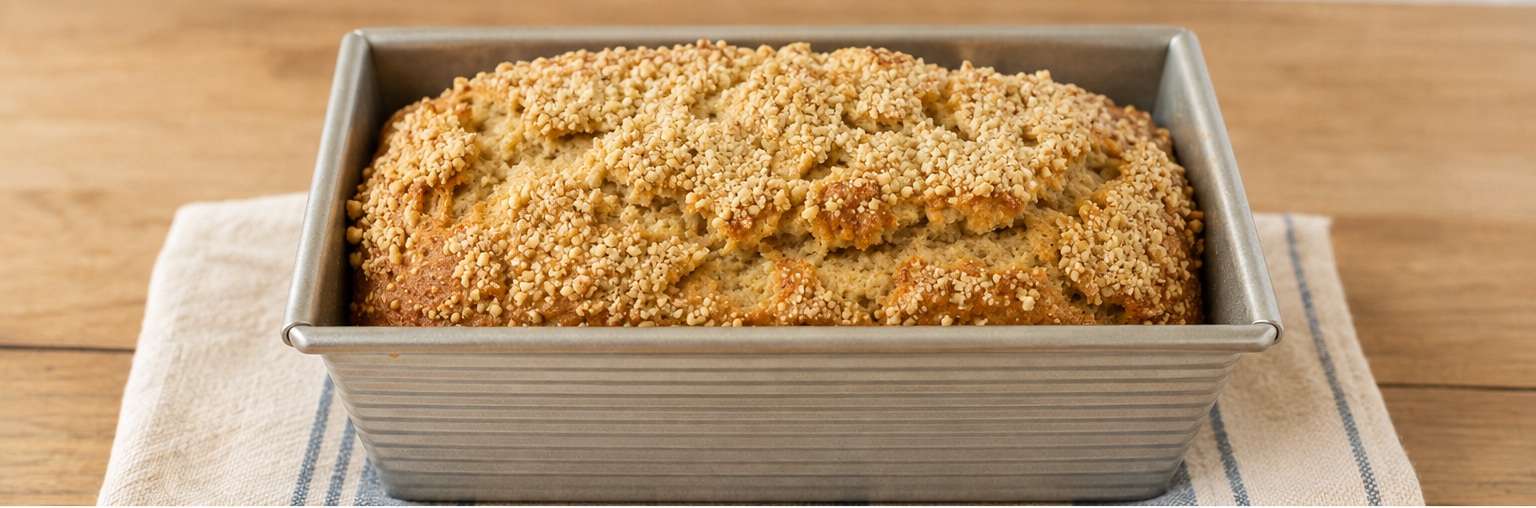
Against every reasonable expectation, it worked.
Eventually I checked Mom's banana bread with a toothpick.
Yes.
A toothpick.
After announcing earlier that I didn't own one for safety reasons and proposing a sword as the responsible alternative, I somehow acquired a toothpick.
It came out pretty clean.
I took the bread out of the oven.
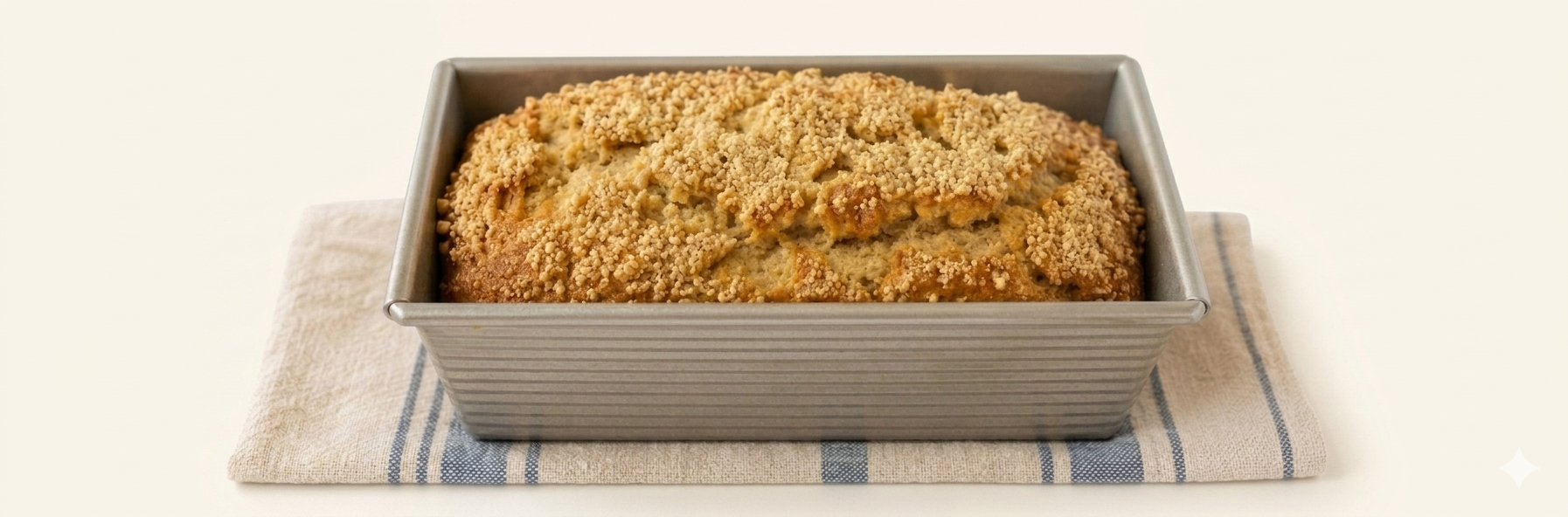
And against every reasonable expectation, it was beautiful.
It had risen perfectly.
Golden brown.
A split crown down the center.
Chopped nuts toasted across the top.
It looked like banana bread.
Real banana bread.
Mom's banana bread.
After it cooled, I took it out of the pan.
Actually, considering the entire can of cooking spray, perhaps I should say that the bread and pan agreed to separate.
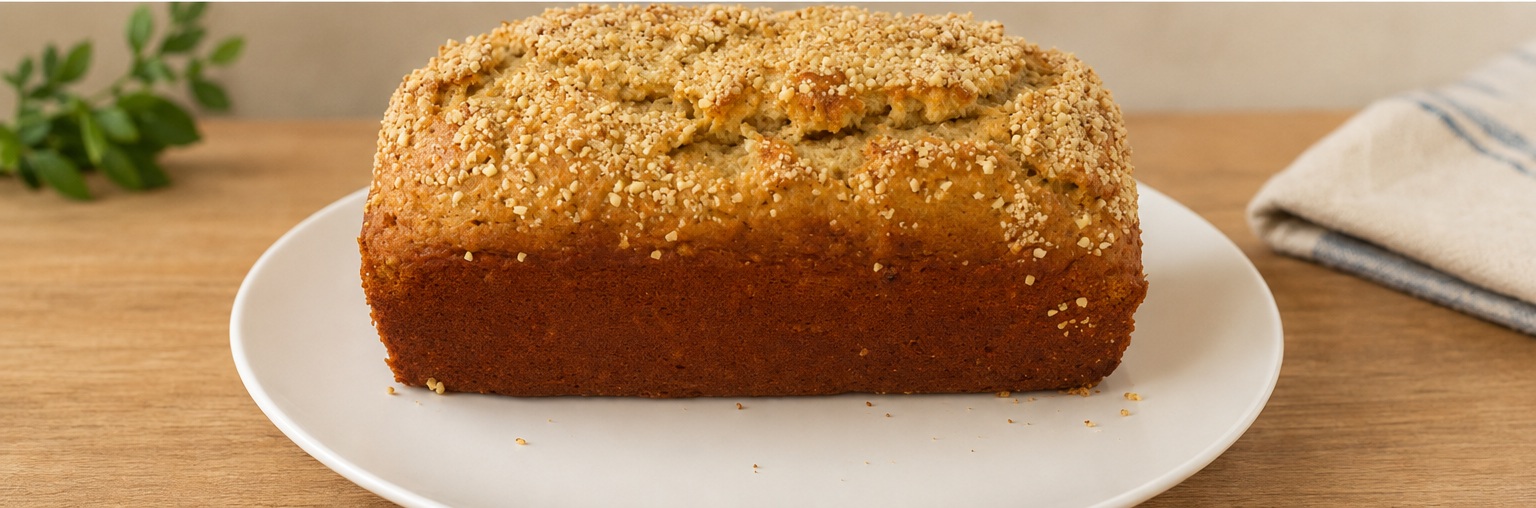
Mom's banana bread, out of the pan.
It sat there on the plate looking remarkably respectable.
After the exploding butter.
After the mysterious oleo.
After Julia's refusal to participate.
After Margaret's plans.
After the vaccinations.
After falling asleep twice during Mass.
After the three ripening bananas.
After the washers.
After the 80W-90.
After the entire can of cooking spray.
After the oven-storage evacuation.
After the sword.
After attempting to apply straight-line accounting principles to baked goods.
There it was.
My invisible kitchen companion, who had spent the afternoon alternately advising me and encouraging behavior no responsible culinary professional would endorse, looked at the picture.
There was a moment of almost stunned silence.
Well, look at that.
We had both expected something considerably worse.
I laughed.
I wondered what Mom would think if she could see the whole production.
Probably:
I gave that boy a perfectly good recipe.
She might shake her head at the microwave.
She would definitely object to the state of the kitchen.
She would have something to say about my interpretation of "grease the pan."
The washers would require an explanation.
The sword might require several.
But maybe eventually she'd laugh.
Maybe that finger would come up.
Of course, after seeing my kitchen, I wouldn't immediately assume this was going to be one of the good times.
I knew that finger.
But perhaps after she had finished saying whatever needed to be said, she'd point it at me again.
"I love you, Michael."
The memories made all the work worthwhile.
The dishes too.
Even the exploded butter.
Because for one afternoon, an old recipe card opened a door.
I remembered my mother differently.
I remembered my father differently.
I remembered them together.
I remembered the home where I grew up.
And I caught another glimpse of that hidden place I have come to love so much:
Nazareth.
The place where God chose to spend most of His earthly life doing things the world barely noticed.
Family.
Work.
Meals.
Faith.
Silence.
Bread.
Love.
Someday I still intend to become a trillionaire through broccoli.
When that happens, Jimmy and Johnny will receive all the credit and all the titles.
Chairman.
CEO.
Whatever else they want.
To God will belong all the honor and glory.
And I'll probably still be sitting where I was when the whole ridiculous dream began:
On my upside-down five-gallon bucket.
Except now I think I know what I'll have with me.
A slice of Mom's banana bread.
Jimmy and Johnny can have the executive chairs.
I'll take the bucket, the banana bread, and the memories.
Perhaps by then I will have learned something my parents seem to have known all along.
A life isn't made sacred by making it impressive.
Sometimes the holiest things are so ordinary that we don't recognize them until years later.
A father going to work.
A mother keeping a home.
Eight children.
Sunday Mass.
A sacramental faith.
A kitchen.
A stained recipe card.
Three ripening bananas.
A loaf of bread.
And somewhere inside all of it, hidden where a child might never think to look:
Love.
Today, on the Feast of the Assumption, I thought I was trying to save three ripening bananas.
Instead, they brought me home.
And someday, if God actually lets me make those broccoli trillions, I hope somebody finds me sitting on that old bucket with Jimmy and Johnny nearby and a piece of banana bread in my hand.
Not because I'm trying to relive the past.
Because some things from the past are worth carrying with you.
The kitchen was still a mess.
Mom would have hated that.
I can almost see that finger coming up.
And frankly, I don't know which version of the finger today's kitchen would have earned.
Probably not the good one.
But after she finished telling me exactly what she thought of the mess...
maybe the finger would come up one more time.
"I love you, Michael."
I love you too, Mom.
And Dad.
Thank you both for our hidden Nazareth.
And thanks for the banana bread.
I'll get to those dishes.
Eventually.
To Him be the honor and glory.
The End